The vocabulary used throughout this book is the vocabulary of linear wave physics: modulation, interference, phase locking, resonance, superposition. That vocabulary is extraordinarily productive at the scales where we have applied it — from gravitational waves through atomic spectra to brainwaves. But honesty requires marking where it stops working.
Linear Composition Has a Ceiling
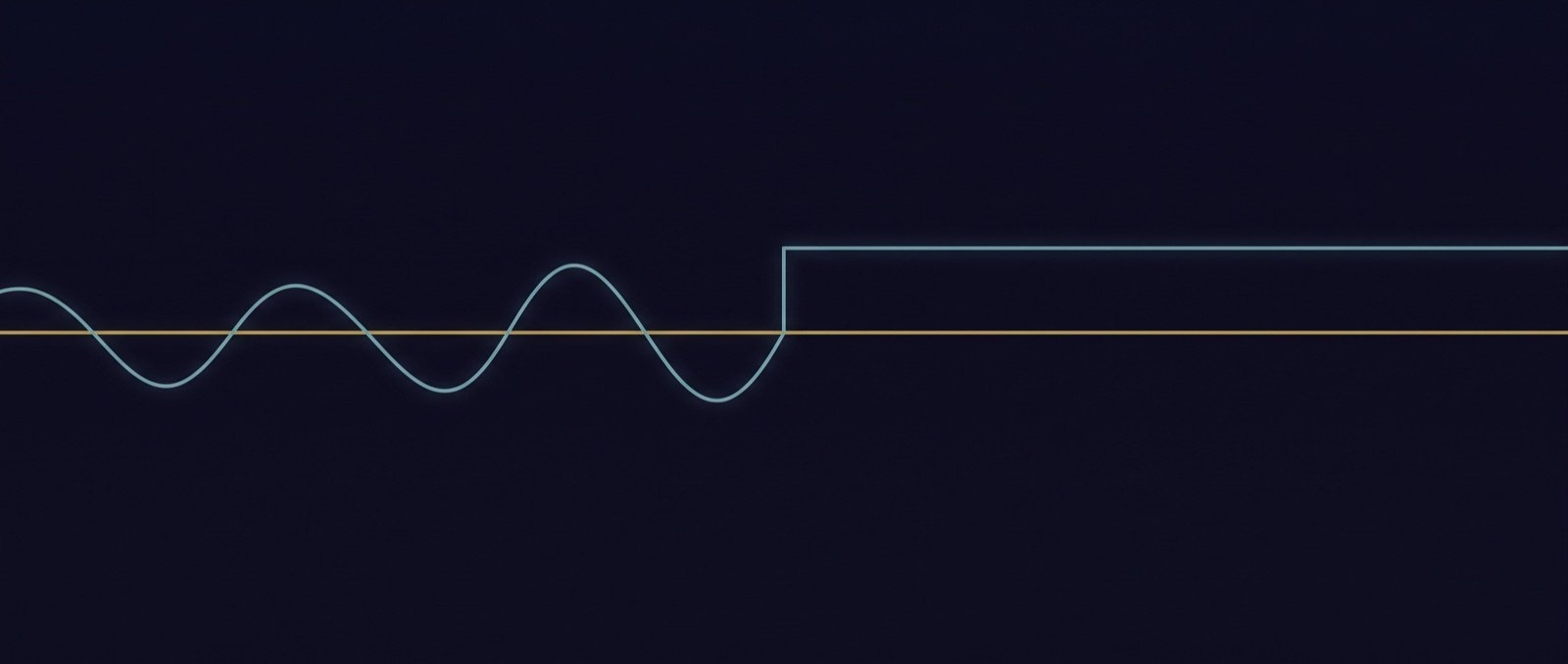
The clearest way to see the limit is by analogy. Take a modern large language model: a hundred layers of matrix multiplications, with a small nonlinear function applied between each layer. Remove the nonlinearities. The model still runs — but a hundred linear maps composed together collapse mathematically into a single linear map. The depth that gives the model its power vanishes. What was rich, surprising, and emergent becomes a shallow input-output relation.
Linear wave physics has the same structure. Two waves can superpose and interfere — but the result is always another wave in the same family, and linear systems do not generate genuinely new categories of behavior. It is worth being precise about where the line falls, because two effects often described in the same breath as interference sit on the other side of it: amplitude modulation is a product of two signals, not a sum, and phase-locking between oscillators requires nonlinear coupling. Neither follows from superposition alone.
In classical systems, thresholds, switches and on/off transitions require nonlinearity. Quantum mechanics is the instructive exception: the Schrödinger equation is linear in ψ, yet discrete spectra, ionisation thresholds and bound-state-to-continuum transitions emerge from a linear eigenvalue problem with boundary conditions. Discreteness as such is therefore not proof of nonlinearity — but the threshold behaviour that governs biology is classical, and there the rule holds.
And nonlinearity is exactly where biology lives.
Where Biology Departs From the Wave Picture
A covalent bond is more than a wave resonance — it is a discrete quantum state with a sharp dissociation threshold, even when it can be addressed by resonant excitation. A neuron does not fire by reaching a vibrational maximum — it integrates inputs and then, at threshold, produces a discrete action potential, regardless of how that input arrived. Gene expression is governed by cooperative binding events and switch-like thresholds, not by continuous wave modulation, even when its envelope looks graded. Protein folding follows energy landscapes with sharp basins, not smooth waves.
These are not edge cases. They are the load-bearing mechanics of life. And the wave vocabulary, on its own, cannot reach them.
Where the Lens Illuminates, and Where It Strains
Where this framework genuinely excels is in domains where linear wave behavior is the underlying physics — electromagnetic propagation in vacuum, electron orbitals, photon emission, atomic spectra, small-amplitude acoustics. There the frequency lens organizes the territory cleanly, because the territory really is a wave landscape.
Gravitational radiation deserves a caveat rather than a place on that list. The Einstein field equations are nonlinear; gravitational waves behave linearly only in the weak-field limit, far from the source. The merger phase this framework points to elsewhere — the moment two black holes coalesce — is precisely the strong-field regime where that linearity fails and only numerical relativity applies. The wave description of what LIGO detects is sound; the description of what produced it is not a linear one.
Where the framework strains is in domains where the underlying physics is fundamentally nonlinear — covalent chemistry, neural computation, gene regulation, anything involving thresholds, switches, or genuine emergence. There the lens describes what we observe in wave-like terms, but it does not explain the structure that makes those observations possible.
A complete account of biology and consciousness will need to combine the wave layer — real, measurable, genuinely there — with a nonlinear layer that the wave layer does not contain. Biophotons exist; their coordination matters. Brain synchronization is measurable; it correlates with cognition. But the neuron's essential computational element is not its resonance — even where intrinsic resonance is present — but its threshold.
One More Limit: The Words Themselves
There is a second way this vocabulary strains, and it is easier to miss than the first. A handful of words in this book do several jobs at once. Each job is legitimate; the trouble is that a reader who meets the word in one sense can carry that sense into a passage where a different one is meant — and the argument then looks stronger than it is. The table below fixes one definition per term and marks where the word is doing something looser.
| Term | The one definition used here | Where it means something else — and does not transfer |
|---|---|---|
| Coherence | A fixed phase relationship between oscillations, maintained over a stated time or distance. This is the optical and quantum sense, and it is measurable. | At least four other things wear the same word: a heart-rate-variability spectral power ratio; EEG synchrony between regions; sub-Poissonian photon-count statistics in Popp's measurements; and the name of this project. These are four different measurements. None of them implies any of the others, and none of them is quantum coherence. |
| Phase-locking | Two oscillators settling into a fixed phase relation through nonlinear coupling. As noted above, this does not follow from superposition. | Not entanglement. The framework explicitly does not claim that classical phase-locking explains entangled correlations — Bell's theorem and the loophole-free experiments rule out that reading. Hebbian coordination in neural tissue is a legitimate use; entanglement is not. |
| Carrier wave | The signal-engineering sense: a wave whose amplitude, frequency or phase is modulated in order to carry information. | For gravity it has been demoted rather than kept: the fundamental layer is an emergent envelope, and the carrier-wave image now names only the macroscopic surface. Where this book still uses the term as a live hypothesis — DNA — it is an open analogy with a stated falsifier, not an established mechanism. |
| Resolution | The smallest interval a substrate or a measurement can distinguish. | Applied to the Planck scale this is a claim about the world; applied to perception it is a claim about an observer. They are different kinds of claim, and the second provides no evidence for the first — the shared word is the only thing connecting them. |
| Modulation | A product of two signals — not a sum, and not interference. One clarification, since signal engineering calls AM "linear modulation" (it is linear in the information signal): the point here is that no linear time-invariant operation on two summed signals can produce their product. That needs a nonlinear or time-varying element — a mixer. | Elsewhere in these chapters it sometimes stands in for the general idea of one thing influencing another. Where it does, it is a metaphor organising intuition; only where it means the product is it an operator with mathematical content. |
A framework that reuses a precise word in an imprecise place inherits the precision without earning it — which is exactly the failure mode this coda exists to guard against.
The Honest Frontier
To put it as directly as possible: this book reframes phenomena that already have linear wave structure, and where it does that it stands on solid ground. Where it gestures toward biology, ancient knowledge, or consciousness as further "frequency phenomena," it offers a metaphor that organizes intuition — not a mechanism that explains. The metaphor is useful. The mechanism remains to be built. And building it will require honesty about what wave language can and cannot do.
That honesty is the price of admission.
This framework is not a theory of everything. It is a lens through which a great deal becomes visible — and a frontier, drawn in the right place, beyond which a different kind of work is needed.
Last updated: