What survived the falsification
In 2016, Schwarze and colleagues at the Mouritsen lab ran a double-blinded test of the prediction that migratory birds are 20 dB more sensitive to RF disruption at 1.3 MHz than at neighbouring frequencies. They were not. The prediction failed. That is recorded as #32 — falsified, and it should stay recorded that way.
But a falsification is not the end of a framework. It is the moment a framework finds out what it was actually claiming. The honest question, after #32, is: what stays standing once the strongest version of the claim has fallen?
This page is the answer. The strongest reading of Coherence — that objects themselves are waves — does not survive #32. A more careful reading — that objects emit field signatures, and those signatures determine which couplings can occur — does. The mechanism the original claim was reaching for is still there. The metaphysics around it has to be retired.
§26 — Signature-coupling
Why this note exists
Prediction #32 was a clean falsification (Schwarze et al. 2016, double-blinded, narrow-band 1.315 MHz vs. broadband ~2 kHz–9 MHz). It removed one specific claim — that bird magnetoreception has a sharp Larmor-peak filter at 1.3 MHz — and exposed a deeper question: which parts of the Coherence framework depended on that claim, and which parts survive without it?
The answer, after careful audit, is that the mechanism (coherent EM coupling between biological systems and ambient fields) survives, and the ontology (objects are waves) does not. This page formalises that distinction in two explicit layers, so that future predictions and the manuscript itself can be cleanly anchored.
Layer 1 — Established physics
These facts are mainstream and require no defence from Coherence:
- Accelerated charges radiate. Any charged particle undergoing acceleration emits electromagnetic radiation (Larmor formula).
- Rotating charge distributions carry multipole moments. A particle or composite system has electric dipole, magnetic dipole, electric quadrupole, and higher multipole moments — each radiating with its own angular pattern.
- Couplings are gated by resonance and selection rules. Whether two systems exchange energy efficiently depends on whether their frequencies, phases, and quantum numbers (spin, parity, angular momentum) permit it. This is the engine of atomic spectroscopy, nuclear physics, FRET energy transfer, cavity QED, and non-linear optics.
- In bound systems, effective properties differ from free-particle values. Electrons in semiconductors have effective masses different from m_e; Landé g-factors in atoms differ from the free-electron g-factor; polaron and Lamb-shift effects are routine — without changing fundamental constants, which remain invariant to ~10⁻¹² precision.
None of this is new. All of it is in standard QFT and condensed-matter textbooks.
Layer 2 — The Coherence-specific claim
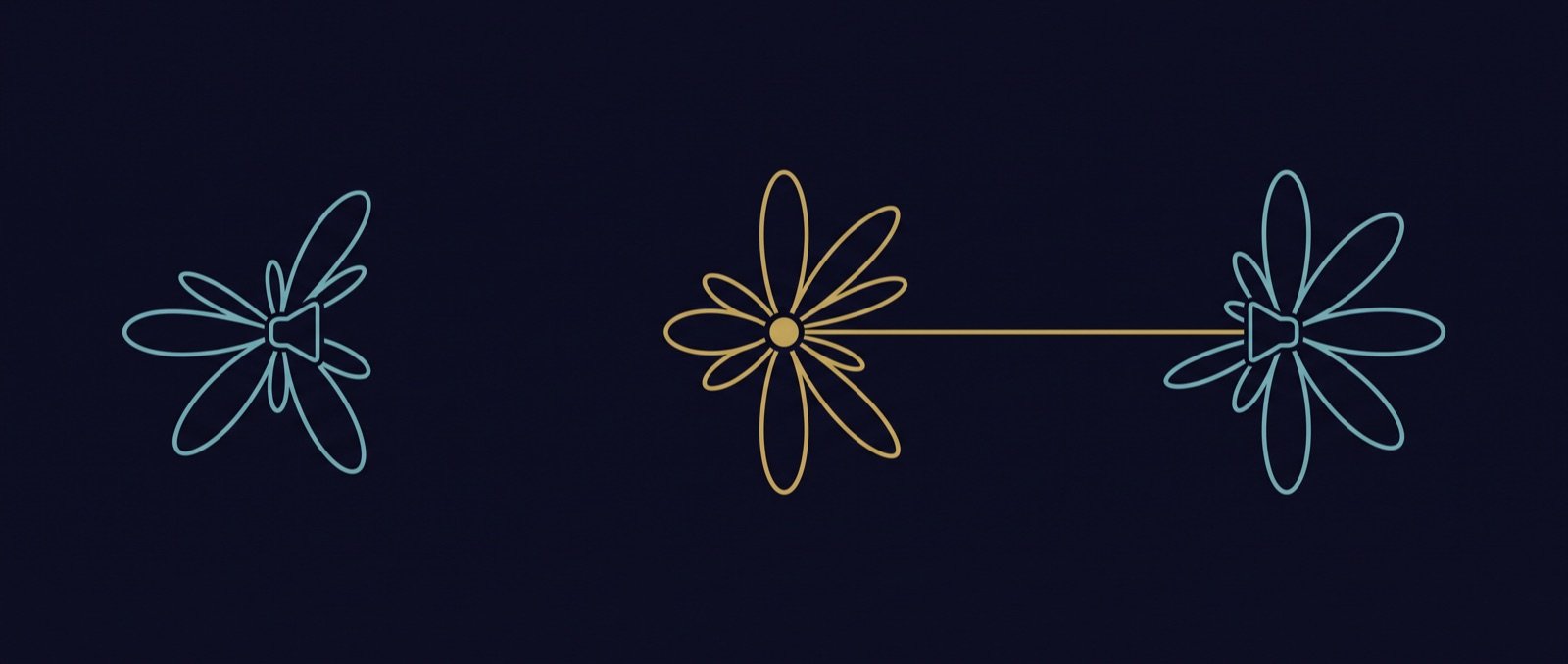
Matching signature couples; mismatched signature does not — gating, not resonance alone
Coherence proposes that the full field signature of a particle or system — not only its charge and mass, but the pattern of its emitted waves, their phase relations, frequency content, and directional asymmetries — functions as a gating mechanism: it co-determines with which other signatures coupling, energy transfer, or mutual influence is possible.
Two particles with identical fundamental constants can therefore behave functionally differently in different contexts — not because their mass or charge differs, but because their signature-environment opens or closes different couplings.
At molecular and biological scales, this implies that collective phase relations between many particles can determine which processes become possible — extending known resonance and selection-rule physics into regimes where mainstream theory rarely looks.
Relation to established work
The building blocks are mainstream: selection rules (Dirac 1927), Förster resonance energy transfer (Förster 1948), phase-matching in non-linear optics (Bloembergen 1960s), coherent control (Tannor–Rice 1985, Shapiro–Brumer), and cavity QED mode-matching. The generalisation — that signature-gating is a system-level mechanism that biological systems may functionally exploit — connects to the Fröhlich–McFadden tradition (Fröhlich 1968 on coherent biological EM modes; McFadden’s CEMI theory of electromagnetic information in nervous systems), without adopting their specific quantitative predictions.
Structural objections, applied
Three structural objections from a befriended physics professor were applied to this formulation:
- Fourier-as-lens — Layer 2 does not claim that a particle is a sum of Fourier modes. It claims that the EM radiation emitted by a particle (or system) has physical frequency and phase content, which is directly measurable with standard instruments. ✅ No lens-confusion.
- Linearity boundary — superposition and phase-coherence are properly defined in linear regimes. Layer 2 confines itself to gating/resonance, which extends into non-linear regimes (and indeed becomes more selective there, as in non-linear optics). The further claim that biological systems functionally exploit room-temperature phase coherence is a separate hypothesis tested by predictions #33 and #36, not asserted here. ⚠️ Scope-limited.
- Bell — signature-coupling is local field-mediation. No non-local hidden variables. Bell-experiments are respected. ✅ Clean.
What Layer 2 explicitly does not claim
- That fundamental constants vary with environment. They do not (precision: ~10⁻¹²).
- That non-local or superluminal influences exist. They do not (Bell tests respected).
- That macroscopic objects are themselves waves. They are not — this is exactly what was falsified by #32 (Schwarze 2016).
A note on neutral particles
A natural intuition is that “neutral particles” (those without net electric charge) play a binding or carrier role. In the refined formulation:
- Force carriers (gauge bosons: photons, gluons, W/Z) mediate the fundamental interactions. Photons mediate electromagnetism; gluons couple quarks via the strong force.
- Composite-neutral particles (notably neutrons) play structural roles in nuclei via pion-mediated residual strong-force binding.
- Neutrinos, which couple only via the weak force and gravity, do not play a structural binding role and are not part of the gating mechanism described here.
The phrasing matters: force-carrier bosons and composite-neutral hadrons fulfil binding roles at different levels, not as a single unified “carrier wave” of the atom.
Consequences for the prediction set
| # | How signature-coupling changes the reading |
|---|---|
| #32 | The falsified version (sharp 1.3 MHz filter) stays falsified. The reformulation — broadband signature-coupling disruption — is consistent with Layer 2 and remains testable. Caveat (2026): whether RF disruption acts on cryptochrome at all is now contested — modulated MHz fields disorient birds at lower power than unmodulated ones, inconsistent with the cryptochrome spin-decoherence prediction they tested, pointing to a separate, probably induction-based sense (Kavokin et al. 2026, J. R. Soc. Interface). The reformulation inherits that uncertainty. |
| #33 | Water-THz × bird navigation: a direct signature-coupling prediction. Layer 2 supplies the mechanism without overcommitting on ontology. |
| #36 | Schumann × L-chirality: signature-coupling between geo-EM and molecular chirality. CISS literature (Ozturk 2023) supplies adjacent support; the specific 7.83 Hz claim remains untested. |
| #37 | Breit-Wheeler pair production: field-mediated mass genesis, consistent with Layer 2’s field-primary stance. |
| #39 | Finite super-luminal entanglement carrier: compatible in spirit (both posit field-level mediation) — but in direct tension with no-signalling: Bancal et al. 2012 showed that any finite-speed influence reproducing quantum correlations permits superluminal signalling. See the #39 verdict on the originals page. |
| #40 | Emergent gravity from substrate clustering: same logical layer as Layer 2 — collective field behaviour rather than particle-essentialism. |
| #42 | Hardness gates chiral inversion (Mohs ↔ inversion energy): a textbook signature-coupling prediction — the mechanical/elastic signature of the host matrix gates the energy needed for a chemical-chirality reconfiguration. Direct Layer 2 application across mechanical and chemical signatures. |
| #43 | Forensic phase-information limit: threshold-based information loss at impact. Connects to Layer 2 through the boundary case — when a coupling event is irreversible, the gating relation between pre- and post-event signatures is severed, setting an information limit. |
| #44 | Time-cumulative cymatic structure in colloidal suspensions: extends Layer 2 into the time domain — repeated signature exposure can accumulate into stable structural gating, not only instantaneous resonance. |
No prior prediction is contradicted by this reframing. Several — notably #42 — are direct applications of Layer 2 across previously disconnected scales.
Methodological status
Layer 1 requires no defence. Layer 2 is the genuine theoretical content of this note; it is consistent with established physics, respects Bell, does not depend on Fourier-as-ontology, and is empirically testable via predictions #33 and #36. Where it goes beyond the literature is in generalising selection-rule and resonance gating to system-level signatures — a generalisation that has partial precedents in the Fröhlich–McFadden line but is not standard.
This is not a prediction with a verdict. It is the theoretical infrastructure that subsequent predictions stand on. Its job is to make the framework’s claims auditable, not to make new empirical commitments.
A note to working researchers
If you read this and disagree — particularly with Layer 2 — the framework wants the disagreement. Sharper objections to the gating claim, or proposals for cleaner empirical tests, are welcome at marald@gmail.com.
Last updated: