Methodology
This research package contains three complete analysis pipelines for three predictions of the sub-quantum grid model (one, #15, under review). Each pipeline is executable against existing public data — no new experiment needs to be set up.
The three predictions in this section all ask the same underlying question in three different ways: does the universe have a smallest unit? If reality is built on a discrete substrate at the Planck scale — a “grid” — then independent kinds of measurement might show signatures of it. Each one targets a different scale: subatomic (pair production), cosmic (gamma-ray bursts travelling across the universe), and gravitational (pulsars warping spacetime).
The honest part is what falsifies each one. One of the three (#17) is testable today against data that already exists; #18 needs an instrument that comes online around 2032. The third (#15, gamma-ray bursts) is under review: under the framework’s current choice of substrate it no longer predicts a signal that burst timing can see.
| # | Prediction | Data source | Script | Plot |
|---|---|---|---|---|
| 17 | Helix-resonance peaks in pair production | CERN Open Data / HEPData | prediction17_pair_production.py | below |
| 15 | Planck-scale photon dispersion — under review | Fermi-LAT / LHAASO GRB bounds | prediction15_fermi_lat.py | below |
| 18 | Non-linear Shapiro delay | NANOGrav / NICER | prediction18_pulsar_timing.py | below |
All scripts run on Python 3.8+ with numpy, matplotlib, and scipy.
Prediction #17 — Helix Stability Threshold in Pair Production
The idea in plain English. When two photons collide at high enough energy, they can
produce an electron–positron pair — pure energy turning into matter. This is established
physics (the Breit-Wheeler process, first directly observed by STAR in 2021). The grid
model adds one extra claim: if matter is a standing-wave configuration in a discrete
substrate, then the cross-section for this conversion should not be perfectly smooth.
It should show small bumps — resonance peaks — at integer multiples of the threshold
energy 2 m_e c² ≈ 1.022 MeV. The peaks would be where photon frequencies fit exactly
into stable standing-wave configurations.
Why this is the sharpest test. QED already predicts the smooth cross-section to about eight decimal places. Any deviation, however small, would be a fundamental discovery — and conversely, a clean confirmation that the curve is smooth at 0.01% precision would falsify the resonance picture cleanly. There is no ambiguity in the verdict.
What it would take to test today. CERN has open data; HEPData publishes pair-production cross-section tables. The Python pipeline runs the Breit-Wigner peak detection on those tables — replace the simulation input with real data, run the script, get a result. Estimated turnaround: weeks, not years.
Core hypothesis
Pair production (γ → e⁺e⁻) shows resonance peaks at harmonics of 2 m_e c² = 1.022 MeV.
The peaks have a Breit-Wigner profile and decay as 1/n² with harmonic number n.
Why this is the sharpest test
QED predicts the pair-production cross-section to 8+ decimal places of accuracy. Any deviation, however small, would be a fundamental discovery. Moreover: the resonance peaks at harmonics are a unique prediction of the grid model — no other framework predicts peaks at exactly these energies.
Required data
- Pair-production cross-section measurements near threshold (1–10 MeV)
- CERN Open Data: LEP / OPAL / DELPHI datasets
- HEPData: published cross-section tables
- Ideally: high-resolution energy scans (ΔE < 0.05 MeV)
Required statistics
| Signal amplitude | 3σ detection requires | Feasibility |
|---|---|---|
| 1% of QED | 18 million events | Achievable with existing CERN data |
| 0.1% of QED | 1.8 billion events | High-luminosity or combined |
| 0.01% of QED | 180 billion events | Future (FCC) |
Generated plot
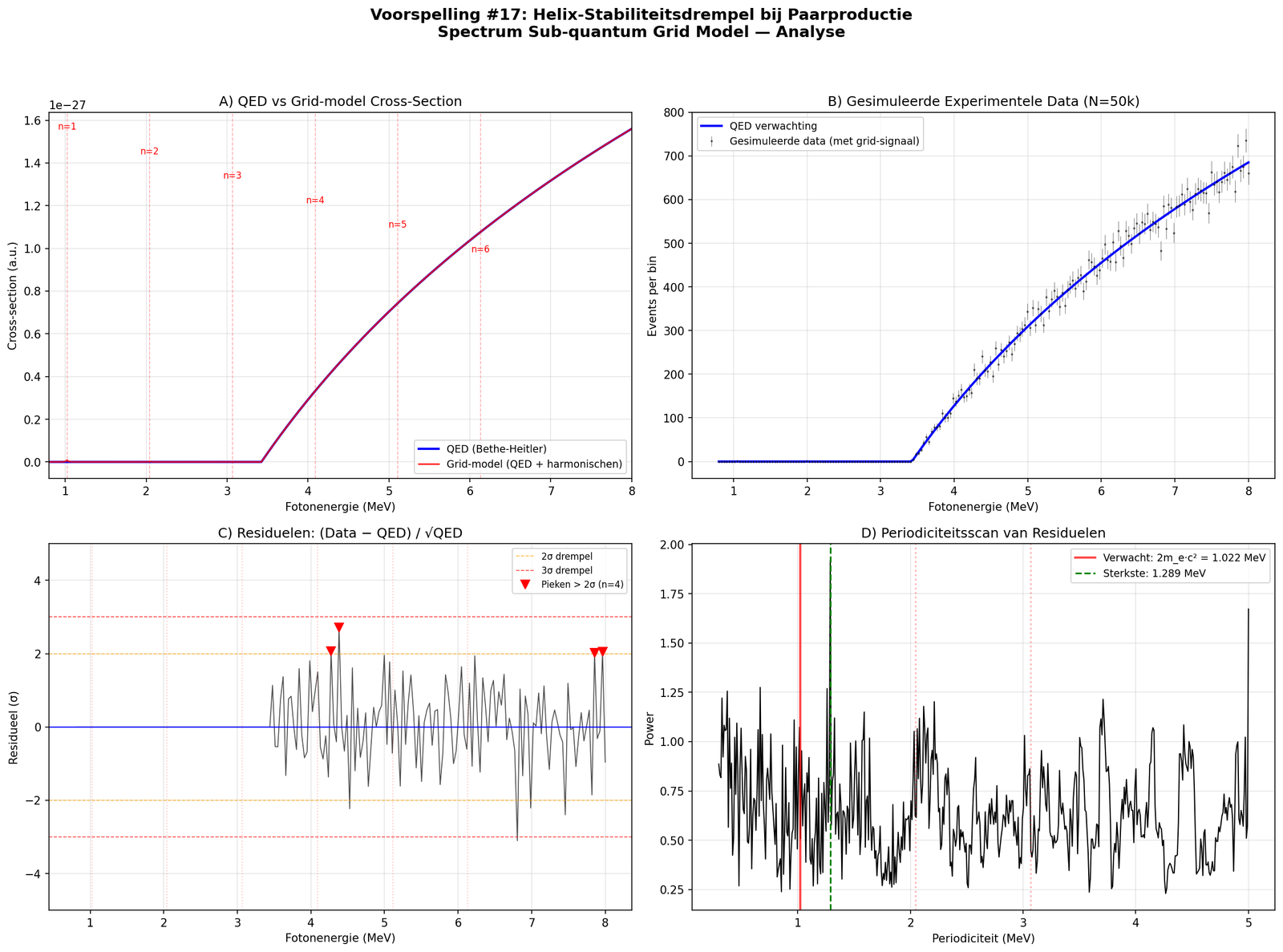
Fig. 1 — Simulated 1% resonance peaks at n=1,2,3,4 harmonics of 1.022 MeV. Run the script with real HEPData CSVs to replace the simulation.
Prediction #15 — Planck-Scale Photon Dispersion (under review)
In one line: the data tell us what kind of grid is allowed — not yet whether there is one.
The idea in plain English. If space is made of discrete pixels at the Planck scale, high-energy photons might “feel” that texture slightly differently from low-energy ones. Over short distances the effect is invisible. But across cosmological distances — billions of light-years — a tiny per-step delay could add up to something measurable. Gamma-ray bursts (GRBs) are a natural test: a single explosion emits photons across a huge energy range, all at once, and we measure their arrival times.
What changed (September 2026). An earlier version of this page gave each possible grid geometry — hexagonal, face-centred cubic, amorphous — its own number for how strongly it would delay high-energy photons, and read a 2009 Fermi measurement as “ruling out a cubic grid”. Those numbers were never derived from the model, and they are withdrawn. Worse, the hexagonal value was already excluded by a 2013 Fermi analysis when it was published here. Since then the measurements have become sharper still: the brightest gamma-ray burst ever recorded, GRB 221009A, observed by the LHAASO observatory, pushes a first-order slowing of high-energy light beyond ten times the Planck energy.
The working choice. Separately, the framework has made a choice about what its grid is. The current working choice (September 2026) is a random substrate: points scattered at random through space and time at a fixed average density — about one per Planck-sized four-volume — with no fixed positions and no minimum length. Mathematically, such a structure picks out no preferred direction and no preferred rest frame, so it does not make light of different energies travel at systematically different speeds, at any order.
What that costs. Honestly: #15 loses its content as a test. A sceptic can fairly call this moving the goalposts — the framework now works with a substrate that the timing data cannot touch. The choice was made mainly for a theoretical reason (see below), not because the data forced it; a symmetric fixed lattice would also have survived these bounds. Either way, it only earns its keep if the random substrate’s own signature — a tiny random jitter in particle motion — gets a derived, testable number. Until then, nothing in #15 tests the grid. The working hypothesis behind the choice is set out on Occupied or Empty.
Core hypothesis (as originally formulated)
The grid is discrete, so photons of different energy might propagate at slightly different
group velocities: v(E) = c × [1 ± η_n × (E/E_Planck)^n]. Over cosmological distances this
would produce energy-dependent arrival-time differences in gamma-ray bursts. This formulation
assumes a substrate with a preferred frame.
Revision (2026-09): substrate choice
The previous table on this page (n = 1, η ≈ 0.3 / 0.1 / 0.01 for hexagonal / FCC / amorphous,
“Fermi-LAT rules out cubic”) was not derived from the model and is withdrawn.
The framework’s working choice as of 2026-09-27 is a random substrate: elements sprinkled at
random through spacetime at a fixed mean density (about one per Planck four-volume) — a fixed
density, not a fixed cell size or minimum length. For a Poisson sprinkling into Minkowski space
there is no equivariant map from the discrete structure to a spacetime direction, so the
discreteness picks out no preferred frame and does not produce modified dispersion relations
(Bombelli, Henson & Sorkin 2009, Mod. Phys. Lett. A 24, 2579).
The price is locality: in such a structure each element has infinitely many nearest neighbours.
Under this choice the prediction is η_n = 0 for every n: no systematic energy-dependent
delay, so the time-of-flight bounds below are satisfied without testing anything.
A stochastic spread is a separate question. GRB data already bound first-order stochastic (“fuzzy”) dispersion at the Planck scale (Vasileiou et al. 2015, Nature Physics 11, 344), and causal-set models are expected to produce a Lorentz-invariant diffusion in energy-momentum (“swerves”) governed by one or two phenomenological parameters (Dowker, Henson & Sorkin 2004; Philpott, Dowker & Sorkin 2009, PRD 79, 124047). For photons, these drift and diffusion parameters are already bounded by the blackbody shape of the cosmic microwave background (Philpott, Dowker & Sorkin 2009). This framework has not derived values for them. Status of #15: under review.
Why random rather than a fixed lattice? Not because of the bounds below: a fixed lattice with inversion symmetry produces no first-order term and no helicity dependence, and its quadratic term sits far below the quadratic bounds. The main objection to any preferred frame is theoretical — Planck-scale Lorentz violation tends to leak into low-energy physics through quantum (loop) corrections, where it is excluded to high precision, unless something protects it (Collins, Perez, Sudarsky, Urrutia & Vucetich, PRL 93, 191301, 2004).
Current bounds
| Bound (subluminal; 95% CL unless noted) | Source | Order | In this page’s convention |
|---|---|---|---|
| E_QG,1 > 1.2 E_Pl (conservative single-burst limit) | Abdo et al. 2009, Nature 462, 331 (GRB 090510) | n = 1 | η₁ < 0.8 |
| E_QG,1 > 7.6 E_Pl · E_QG,2 > 1.3×10¹¹ GeV | Vasileiou et al. 2013, PRD 87, 122001 (four Fermi-LAT GRBs) | n = 1, 2 | η₁ < 0.13 · η₂ ≲ 10¹⁶ |
| E_QG,1 > 10 E_Pl · E_QG,2 > 6×10⁻⁸ E_Pl | LHAASO (Cao et al.) 2024, PRL 133, 071501 (GRB 221009A) | n = 1, 2 | η₁ < 0.1 · η₂ ≲ 3×10¹⁴ |
| vacuum birefringence |ξ| < 10⁻¹⁵–10⁻¹⁶ | Wei 2025, arXiv:2503.18277 (energy-resolved GRB polarimetry; consistent with earlier γ-ray polarimetry bounds) | helicity-odd, n = 1 | first-order helicity dependence excluded; quadratic birefringence only weakly bounded |
Conversions: η₁ = E_Pl / E_QG,1 and η₂ ≈ (E_Pl / E_QG,2)² with the non-reduced
E_Pl = 1.22 × 10¹⁹ GeV; some papers carry an extra factor (e.g. 3/2 for n = 2), which does not
change the orders of magnitude. The birefringence parameter (called η in Wei 2025) is a different
coefficient and is written ξ here to avoid confusion.
What this means for the grid model
- The withdrawn linear table was already inconsistent with data when it was published. Vasileiou 2013 (η₁ < 0.13) had excluded the hexagonal value (0.3); LHAASO (η₁ < 0.1) now puts the old FCC value (0.1) at the edge.
- What the bounds exclude: substrates that produce first-order (n = 1) dispersion or first-order helicity dependence. A preferred-frame lattice with only quadratic effects of natural size (η₂ ~ 1) is barely constrained by them.
- Working choice (random substrate): no systematic dispersion at any order — consistent with all bounds, and therefore not tested by them. The testable residue is stochastic (swerves), for which the framework has no derived parameter values yet.
- Cost of the choice: besides #15, it affects results that relied on a fixed lattice — for example the resolution-dependent LHC deviations (#1) and Bridge 3’s lattice-derived uncertainty-principle correction. These are listed as consequences under review on Occupied or Empty.
Key GRBs
| GRB | z | Photon energies | Significance |
|---|---|---|---|
| GRB 221009A | 0.151 | TeV afterglow (LHAASO) | Strongest current linear and quadratic time-of-flight bounds |
| GRB 090510 | 0.903 | 31 GeV (Fermi-LAT) | Classic benchmark (Abdo 2009, Vasileiou 2013, 2015) |
| GRB 080916C | 4.35 | 13 GeV | Highest redshift |
| GRB 190114C | 0.42 | ~1 TeV (MAGIC) | First TeV GRB |
Interactive: where the bounds sit
Shaded = excluded (subluminal; 95% CL, *Fermi-LAT 2009 = conservative single-burst limit). η₁ = E_Pl/E_QG,1 and η₂ ≈ (E_Pl/E_QG,2)² with E_Pl = 1.22×10¹⁹ GeV; O(1) convention factors do not change the orders of magnitude. The bounds exclude first-order dispersion; quadratic effects of natural size are allowed. A random, statistically Lorentz-invariant substrate predicts no systematic effect at all — it evades the bounds rather than passing a test.
Prediction #18 — Non-Linear Shapiro Delay
The idea in plain English. When light passes close to a massive object — a star, a black hole — it travels a little slower. General relativity predicts this exactly; the extra delay is called the Shapiro effect, and pulsar timing measures it routinely. The grid model adds a small twist: if mass densifies the local grid (more nodes per volume in the presence of mass-energy), then the slowdown should be slightly non-linear in the gravitational potential — a tiny correction on top of the standard relativistic delay.
Why this is a future test. The correction is small. At current pulsar-timing precision (~5% on the Double Pulsar Shapiro delay), it is invisible. To see it, you need precision about 50× better than today’s best. The Square Kilometre Array, an instrument coming online in stages over 2028–2032, should reach exactly that threshold. So the prediction is falsifiable around 2032 — neither confirmed nor refuted today, but consistent with all current measurements.
What this means in practice. This is a wait-and-watch prediction. The pipeline is in place. The instrument is being built. Around 2032 we’ll know.
Core hypothesis
Mass locally densifies the grid → c decreases locally → extra delay above
standard general-relativistic Shapiro delay. The correction is non-linear:
Δt_grid = Δt_GR × [1 + β × (GM/Rc²)^α] with α > 1Current status
At present timing precision (~5% on Shapiro delay), the signal is not detectable at β = 0.01, α = 2. The grid correction at the Double Pulsar (compactness 0.18) is only ~0.03% — well below current measurement error.
When detectable?
| Instrument | Year | Precision | Detectable at |
|---|---|---|---|
| Kramer et al. 2021 | 2021 | ~5% | β > 10 (excluded) |
| NANOGrav 15yr | 2023 | ~3% | β > 5 |
| SKA Phase 1 | ~2028 | ~0.5% | β > 0.1 |
| SKA Full | ~2032 | ~0.1% | β > 0.01 ← target |
| Next-gen timing | 2035+ | ~0.01% | β > 0.001 |
Strongest test objects
PSR J0737−3039A (Double Pulsar): compactness 0.18, most precise Shapiro measurement. Hulse-Taylor (B1913+16): compactness 0.20, but harder to measure (low inclination).
Generated plot
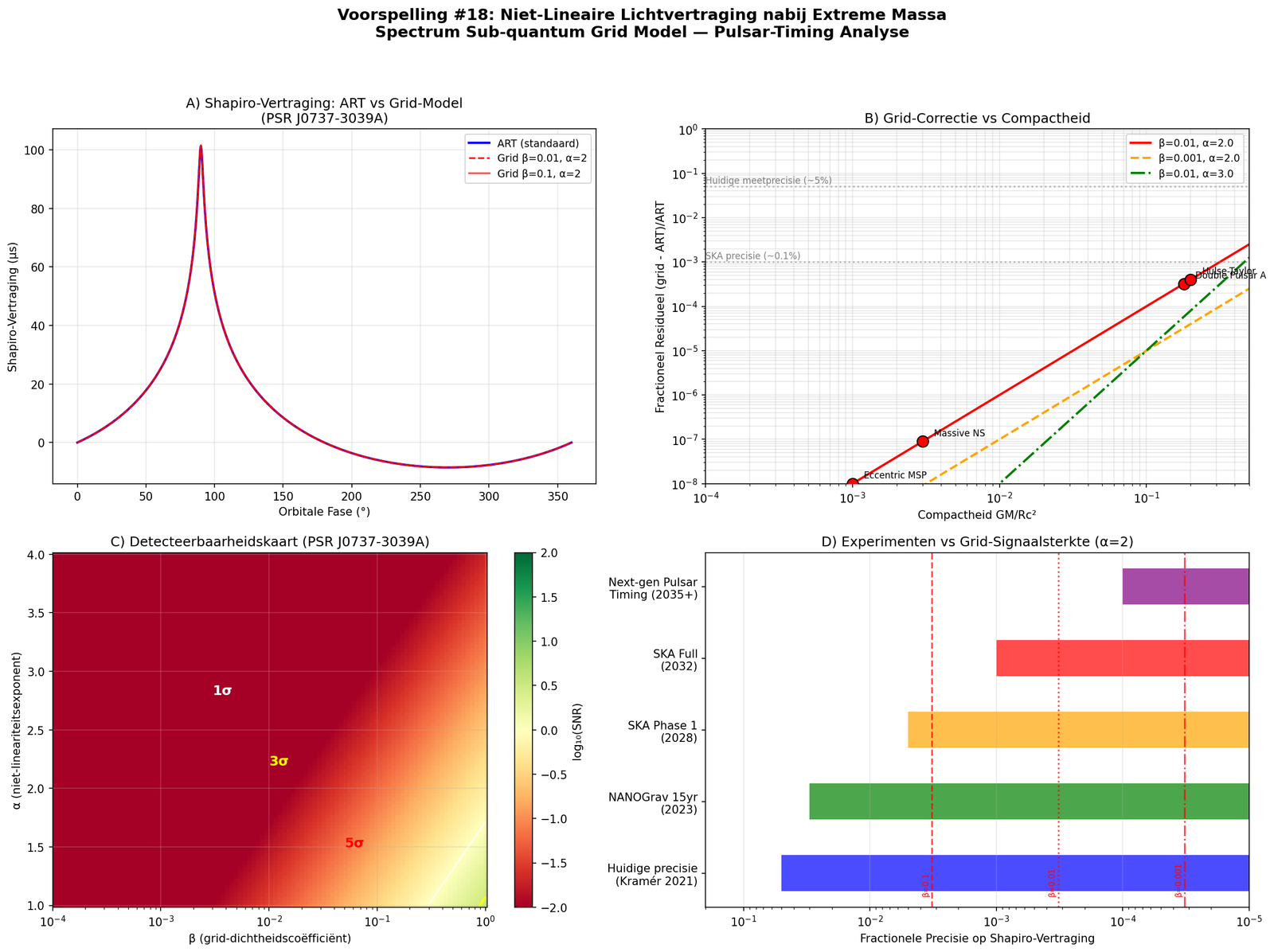
Fig. 2 — Predicted non-linear Shapiro correction (β=0.01, α=2) vs. published timing precision on the Double Pulsar; SKA Full (~2032) is the first instrument that crosses the falsifiability threshold.
Timeline summary
The three predictions span very different timescales — that is part of the point. A framework that only claims things testable in 2050 is hard to take seriously today; a framework that only claims things testable in 1995 has already had its chance. This set covers all three.
- Today: #17 (pair production) can be run against existing CERN data within weeks. #15 (gamma-ray burst dispersion) is under review: under the framework’s working choice of a random substrate it predicts no systematic dispersion, so burst timing cannot test it.
- 2028–2032: #18 (Shapiro delay) waits for the SKA radio telescope to reach the required precision.
If #17 returns a clean negative — no resonance peaks at 0.1% precision — the helix-stability form of the framework is constrained. #15’s bounds rule out substrates with first-order or helicity-dependent dispersion; the framework’s random substrate predicts no systematic effect, so #15 currently tests nothing. If #18 returns null in ~2032, the grid-density model for gravity is ruled out at the β = 0.01 level. The framework is honest about each of these outcomes.
2026 (NOW):
  ├── #17: Re-analyse CERN data for resonance peaks
  │       → Download HEPData cross-sections
  │       → Run prediction17_pair_production.py with real data
  │       → Result within weeks
  │
  └── #15: Under review (2026-09)
          → Random substrate (working choice): η = 0 at every order
          → GRB bounds satisfied, not tested
          → Residual signature: swerves (no derived values yet)

2028–2032 (SKA):
  └── #18: Wait for SKA Phase 1 / Full
          → Monitor Double Pulsar
          → Test non-linear Shapiro correction
          → Result ~2032
Conclusion: #17 is currently the most readily falsifiable. #15 is under review: its bounds exclude first-order and helicity-dependent dispersion, and the chosen random substrate predicts neither. #18 is a future test that validates the grid-density model for gravity.
Source code
All five Python scripts are published openly:
- prediction17_pair_production.py — Breit-Wigner peak detection in cross-section residuals
- prediction17_real_data.py — same pipeline, against real HEPData input
- prediction17_real_data_v2.py — refined v2
- prediction15_fermi_lat.py — withdrawn linear-order model, kept for the record
- prediction18_pulsar_timing.py — non-linear Shapiro delay forecast
Dependencies: numpy, matplotlib, scipy — install with pip install numpy matplotlib scipy.
Citation
Bes, M. (2026). Sub-quantum Grid Model — Testable Predictions. The Spectrum of Everything. https://spectrumofeverything.com/research/grid-analyses/
A note to working researchers
If you have access to CERN HEPData cross-section tables or SKA pulsar-timing data and want to run any of these pipelines against real data, please reach out: marald@gmail.com. The scripts are designed to be replaced at the data-loading stage; the analysis pipeline downstream is unchanged.
Last updated: