How to read this document
Each bridge places one Coherence hypothesis beside the established physics it relates to, then lists the peer-reviewed evidence that links the two. The point is methodological honesty: where does the framework merely rephrase mainstream results, and where does it propose something genuinely additional?
The closing “What if” question on each bridge is the falsifiable seam — the place where the Spectrum reading commits to something testable beyond the mainstream formulation.
This article is part of the Frequency Theory of Everything cluster. Bridge 2 is the place to start if you came looking for entropic / emergent gravity (Verlinde 2017).
Bridge 1 — Mass as Stable Oscillation
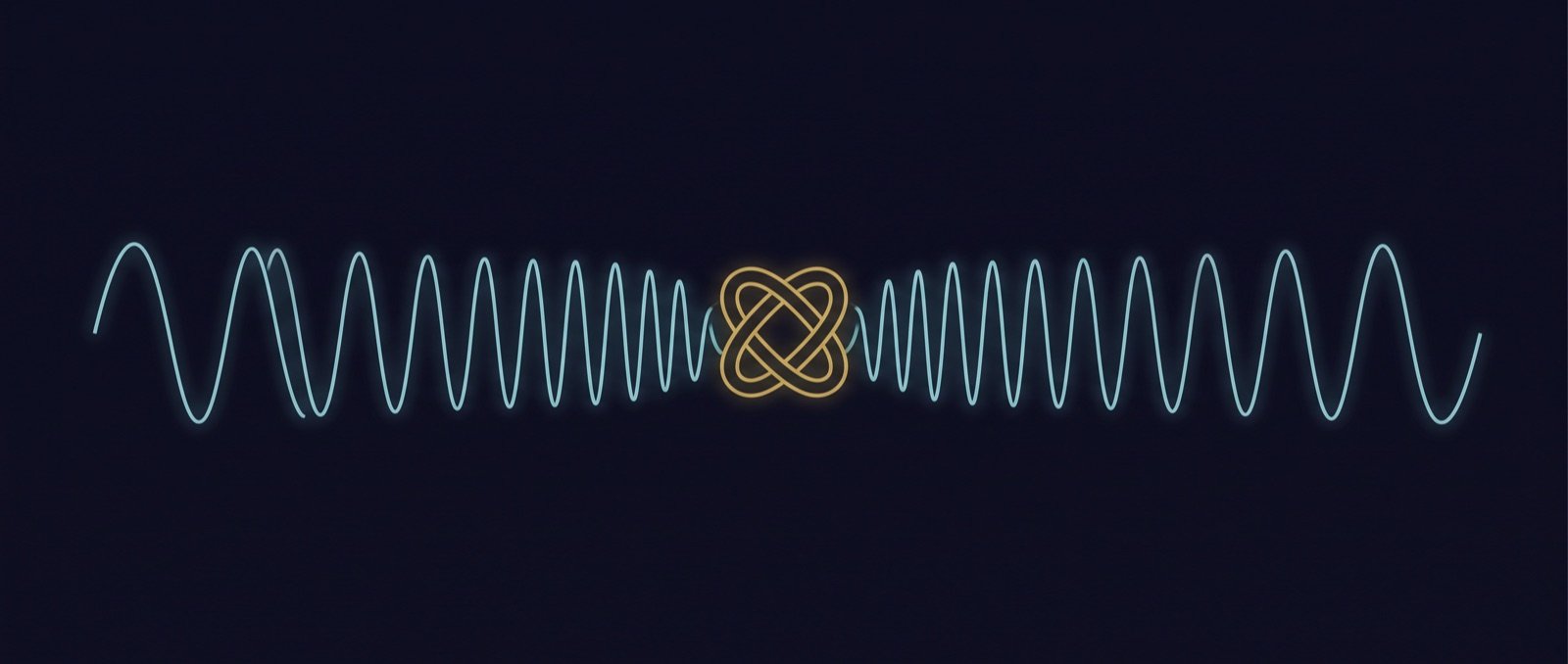
Oscillation localised — what we measure as mass
A note on wording. “Frozen oscillation” was the manuscript’s original image. The current formulation (Chapter 4, since 2026-04) is stable, localised configuration in the substrate: the wave is the process that forms matter, not a frozen object that matter is. The bridge below keeps the older image where it is pedagogically useful and the newer one where it is precise.
The basic move. Standard physics says particles have mass; the Higgs field gives it to them via a coupling mechanism. The Coherence reading says particles are a stable oscillation, and what we measure as mass is the signature of that oscillation. Both formulations make the same numerical predictions — but the second one is more economical ontologically: there is one thing (the oscillation) rather than two (the particle and its mass-property).
Why it is at least worth taking seriously. The Compton relation λ = h / (mc) ties
mass to frequency directly. Pair production turns two photons (pure oscillation) into an
electron–positron pair (matter). Schrödinger showed in 1930 that electrons exhibit an
internal trembling motion — zitterbewegung — at a frequency proportional to their mass.
None of this is new physics; all of it points in the direction the Coherence reading takes.
| Spectrum reading | Established physics |
|---|---|
| Mass is a stable, localised configuration of the substrate, formed by wave interaction; its internal oscillation is what we measure as mass | Higgs mechanism: particles acquire mass via Higgs-field interaction; ~99% of hadron mass is QCD binding dynamics |
c² in E = mc² is a unit-conversion constant; the pair-production threshold 2mₑc² is real but follows from conservation laws, not from a resonance | c² is a dimensional factor (velocity²) |
Supporting evidence:
- Zitterbewegung (Schrödinger 1930): electrons exhibit an internal
oscillation. The zitterbewegung angular frequency is
ω = 2mc²/ℏ ≈ 1.55 × 10²¹ rad/sfor the electron (factor 2 vs. the standard Compton angular frequencymc²/ℏ; see the Compton frequency page for the terminology note). Demonstrated experimentally in a trapped-ion analogue: Gerritsma et al., Nature 463, 68–72 (2010). Spectrum reading: the internal oscillation is the measurable signature of a stable substrate configuration — the process, not the frozen object. (Note: the ion-trap result is a quantum simulation of the Dirac equation, not an observation on free electrons.) - Compton wavelength
λ = h/(mc): a direct mathematical coupling between mass and frequency. At that wavelength a particle behaves as a local entity. - Pair production (γ + γ → e⁺ e⁻): photons create mass — proven physics. First direct observation of the pure Breit-Wheeler channel: STAR Collaboration, Phys. Rev. Lett. 127, 052302 (2021). The Spectrum reinterprets the mechanism, not the outcome.
Bridge 2 — Gravity as an Emergent Envelope
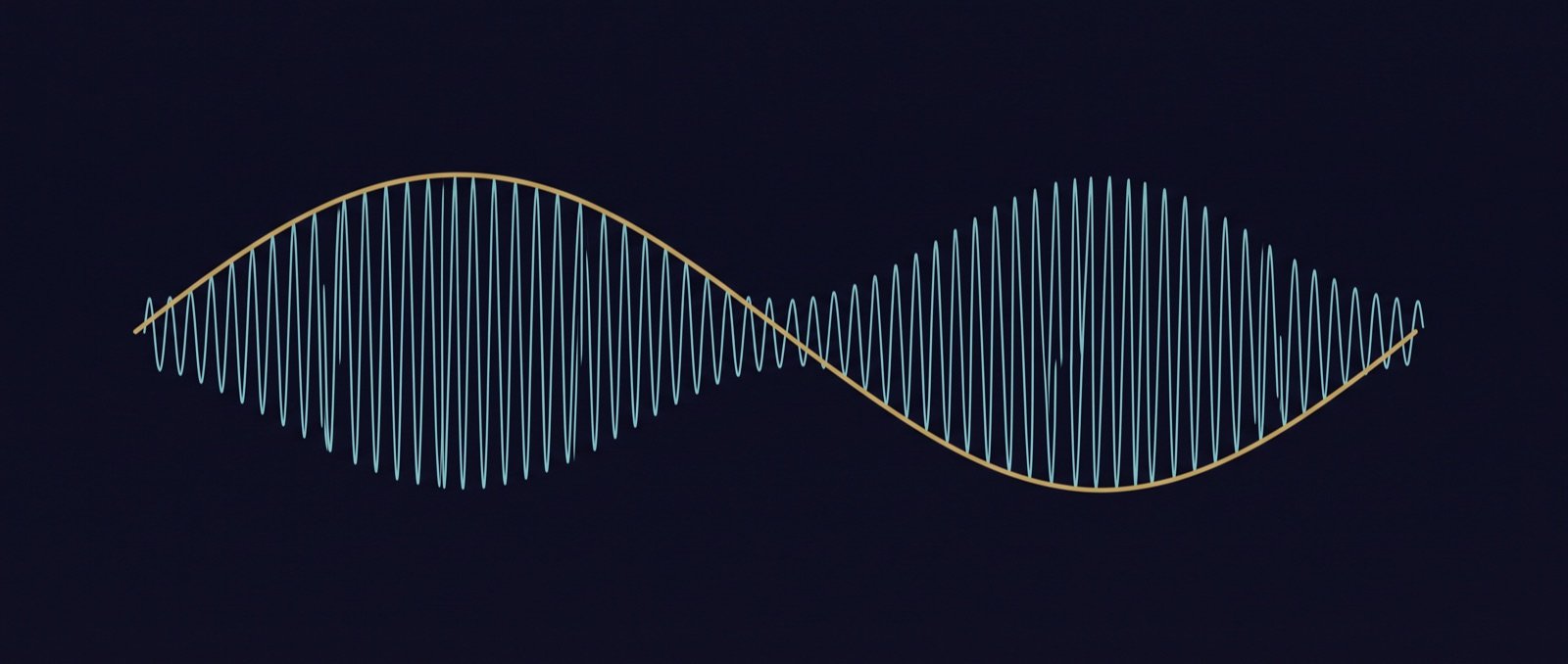
Fast substrate oscillations; the slow envelope is what behaves as gravity
The basic move. General relativity describes gravity as the curvature of spacetime. Verlinde’s 2017 work goes further: gravity is emergent from a deeper substrate, not fundamental. The Coherence reading sits in that same direction. Picture the substrate’s countless fast oscillations: their combined slow pattern — the envelope — is what behaves as gravity. The curvature description rides on top as an effective approximation; the statistical substrate sits underneath. (This nesting is the spirit of Sakharov’s 1967 “induced gravity”.) The older “carrier wave” image then names only the surface — how that slow envelope looks at everyday scale — not a layer deeper than Verlinde.
Why this isn’t a wild claim. LIGO directly detected gravitational waves in 2015 — gravity has frequency, measured in the 35–150 Hz range during black-hole mergers. NANOGrav 2023 detected a nano-Hertz gravitational-wave background — the universe sings at very low frequencies. Calling gravity a wave is no longer speculative; the question is only what the wave does in relation to everything else.
| Spectrum reading | Established physics |
|---|---|
| Gravity is the collective amplitude-envelope of the substrate; spacetime curvature is the effective (spin-2) description on top, the substrate statistics underneath — a Sakharov-style nesting. “Carrier wave” names only the macroscopic surface (a reading, not a formal signal-theory claim) | Gravity is space-time curvature (general relativity); Verlinde 2017 frames gravity as emergent from substrate entropy |
Supporting evidence:
- LIGO (2015): direct detection of gravitational waves — gravity has
frequency. Binary black-hole merger frequency sweep
35 → 150 Hz: Abbott et al., Phys. Rev. Lett. 116, 061102 (2016). - Pulsar Timing Arrays (NANOGrav 2023): nano-Hz background gravitational waves — the universe sings at very low frequencies.
- Verlinde’s emergent gravity (2017): gravity as an entropy-gradient phenomenon, not fundamental — consistent with the envelope reading (gravity as the substrate’s collective slow pattern): Verlinde, SciPost Physics 2(3), 016 (2017).
Bridge 3 — Resolution as a Planck-Scale Grain
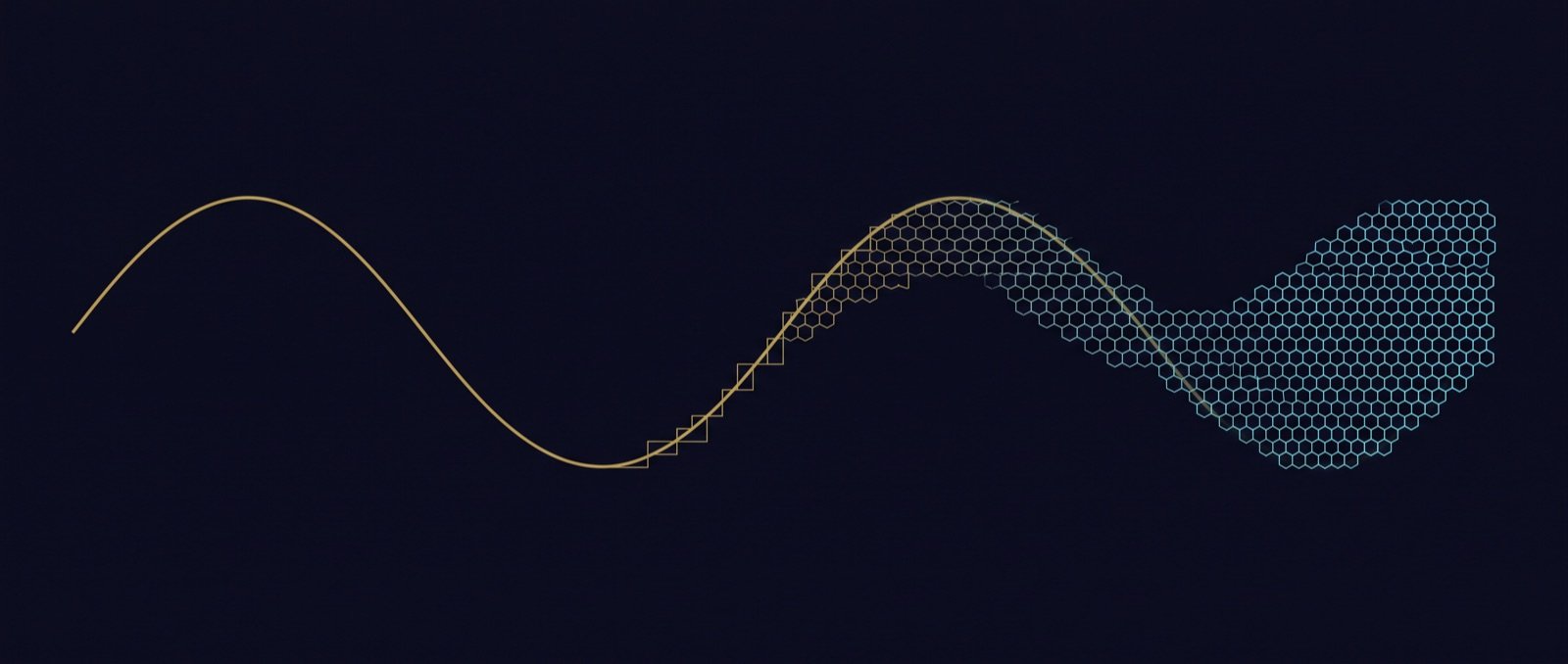
Finite resolution — a random grid leaves no speed signature
The basic move. Physics has a natural smallest scale — the Planck length, about 10⁻³⁵ metres — though as a combination of constants, not as a measured limit. Heisenberg’s uncertainty principle says position and momentum cannot both be measured arbitrarily precisely. The Coherence reading puts these together as a hypothesis: the universe has finite resolution at the Planck scale, the way a digital photo has finite resolution at pixel scale. (A fixed pixel size is the lattice reading; the framework’s current working choice fixes only an average grain density, with no minimum length.) Standard uncertainty already follows from wave mathematics on a continuum; what a grid could add is a correction to it at extreme momenta — though under the framework’s current random-grid choice that correction is under review. Loop Quantum Gravity (Rovelli, Smolin) is the closest formal cousin — discrete spectra for area and volume, though without a lattice or a preferred frame.
What it would take to test. Gamma-ray bursts are the natural test: if space has a grain, the most energetic photons should arrive very slightly out of step. The latest measurement (LHAASO, GRB 221009A) pushes any first-order slowing of high-energy light beyond ten times the Planck energy, and polarisation data exclude, at first order, any grid that treats left- and right-handed light differently. A regular grid that looks the same in both directions would still slip under these limits. The framework’s current working choice (September 2026) is a random grid — points scattered at random through space and time at a fixed average density, with no minimum length — which has no preferred direction and so gives no systematic speed difference at all (see the grid analyses page). That survives every bound, but at a price: burst timing can no longer test it. The data tell us what kind of grid is allowed — not yet whether there is one.
| Spectrum reading | Established physics |
|---|---|
| Planck length is the universe’s minimum pixel size (fixed-lattice reading — under review; the random-substrate working choice has no minimum length) | Planck length is the smallest meaningful distance (~1.616 × 10⁻³⁵ m) |
(Fixed-lattice reading — under review) A Planck grid predicts the Generalized Uncertainty Principle (GUP): Δx · Δp ≥ ℏ/2 · (1 + β l_p² Δp² / ℏ²) — the standard Heisenberg relation is the low-momentum limit (Δp ≪ ℏ/l_p) | Δx · Δp ≥ ℏ/2 follows from [x, p] = iℏ; GUP extension: Maggiore (1993), Adler & Santiago (1999) |
Supporting evidence:
- Loop Quantum Gravity (Rovelli, Smolin): discrete space-time with quanta of volume and area — the closest formal physics gets to a “Planck grid”.
- Information-theoretic QM (Zeilinger): quantum mechanics as an information limit, not as a property of matter.
- Lorentz-invariance constraints from GRB photon timing bound linear dispersion at E_QG,1 > 10 E_Pl (LHAASO, PRL 133, 071501 (2024); earlier Abdo et al., Nature 462, 331 (2009)), and GRB polarimetry bounds vacuum birefringence below ~10⁻¹⁵ (Wei 2025). These exclude substrates with first-order or helicity-dependent dispersion; a preferred-frame lattice with only quadratic effects is barely constrained, and the main objection to it is theoretical (naturalness: Collins et al., PRL 93, 191301, 2004). The framework’s working choice — elements sprinkled at random through spacetime at a fixed density, statistically Lorentz-invariant as in causal-set theory (Bombelli, Henson & Sorkin 2009) — predicts no systematic dispersion and evades them, which also means #15 is no longer a test. See /research/grid-analyses/ for the analysis.
Bridge 4 — Entanglement as Phase Lock
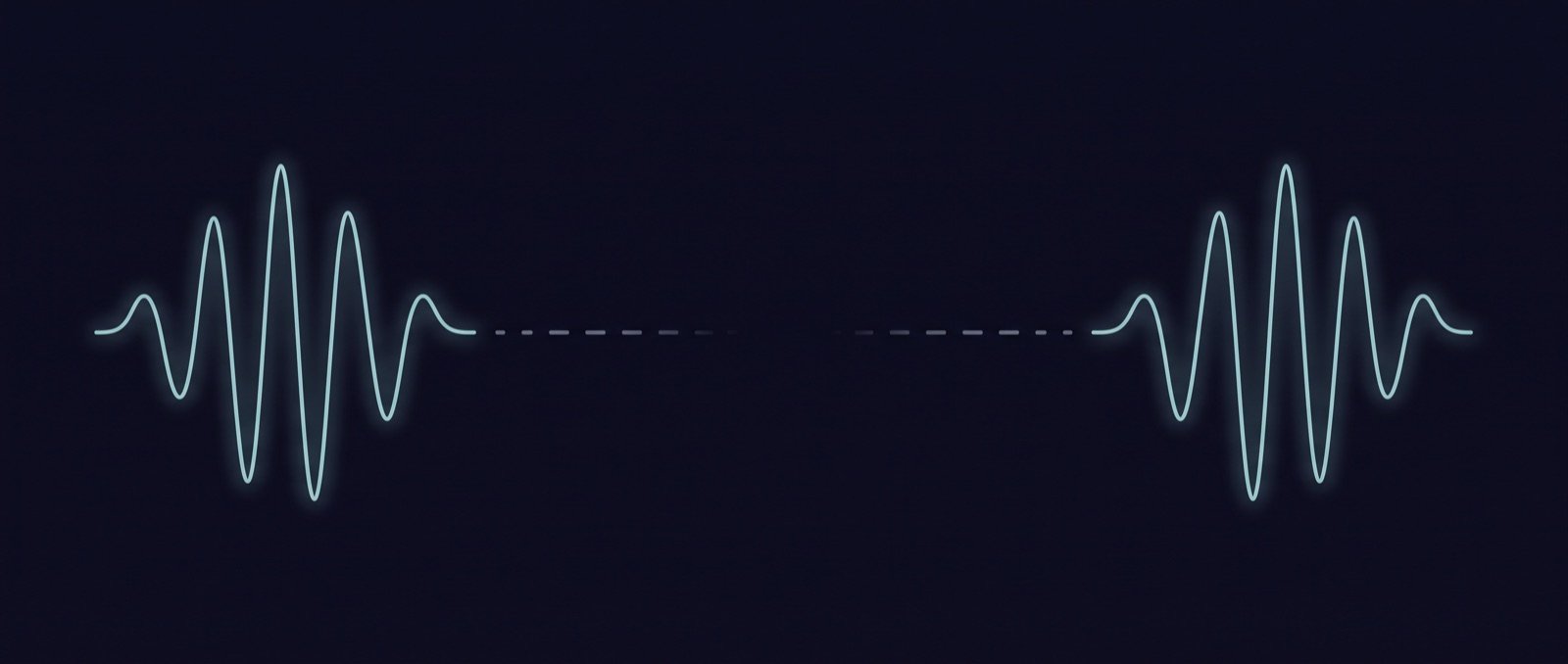
Matched phase, nothing travelling between — the link is deliberately broken
The basic move. Two entangled particles share a connection that cannot be explained by anything travelling between them — Bell’s theorem (1964) proved this rigorously. The Coherence reading does not claim to explain entanglement (Bell’s theorem rules out the naïve phase-locking account). What it does suggest is that the wave vocabulary points toward the right kind of intuition: two particles from one source share a phase relation that was never separated, so no signal needs to travel.
Where this stops. Honest disclosure: this bridge is the weakest of the seven. A classical shared-phase model cannot reproduce all Bell-test correlations. The Coherence reading acknowledges this on the Limits coda — the wave vocabulary reaches toward entanglement but does not fully articulate it.
| Spectrum reading | Established physics |
|---|---|
| Two particles from one source share phase → phase lock | Bell-test correlations exist; no information transfer |
Supporting evidence:
- EPR paradox (Einstein, Podolsky, Rosen 1935): correlations that appear faster than light, but no information transfer.
- Bell tests: quantum correlations proven; interpretation remains open. Aspect 1982; Hensen 2015 loophole-free; Yin 2017 satellite-distance Bell test. 2022 Nobel Prize in Physics awarded for this lineage.
- Sub-luminal carrier bound from Geneva Bell-test:
Salart et al., Nature 454, 861–864 (2008) — lower
bound on hypothetical carrier speed
> 10⁴ × c.
Bell-aware caveat. Bell’s theorem rules out local hidden-variable models that include naïve shared-phase accounts. The Coherence reading is therefore not “phase lock explains Bell” — it is “the wave vocabulary points toward something the classical version cannot fully articulate.” See the Limits coda for the explicit boundary.
Bridge 5 — Consciousness as a Coherent EM Field
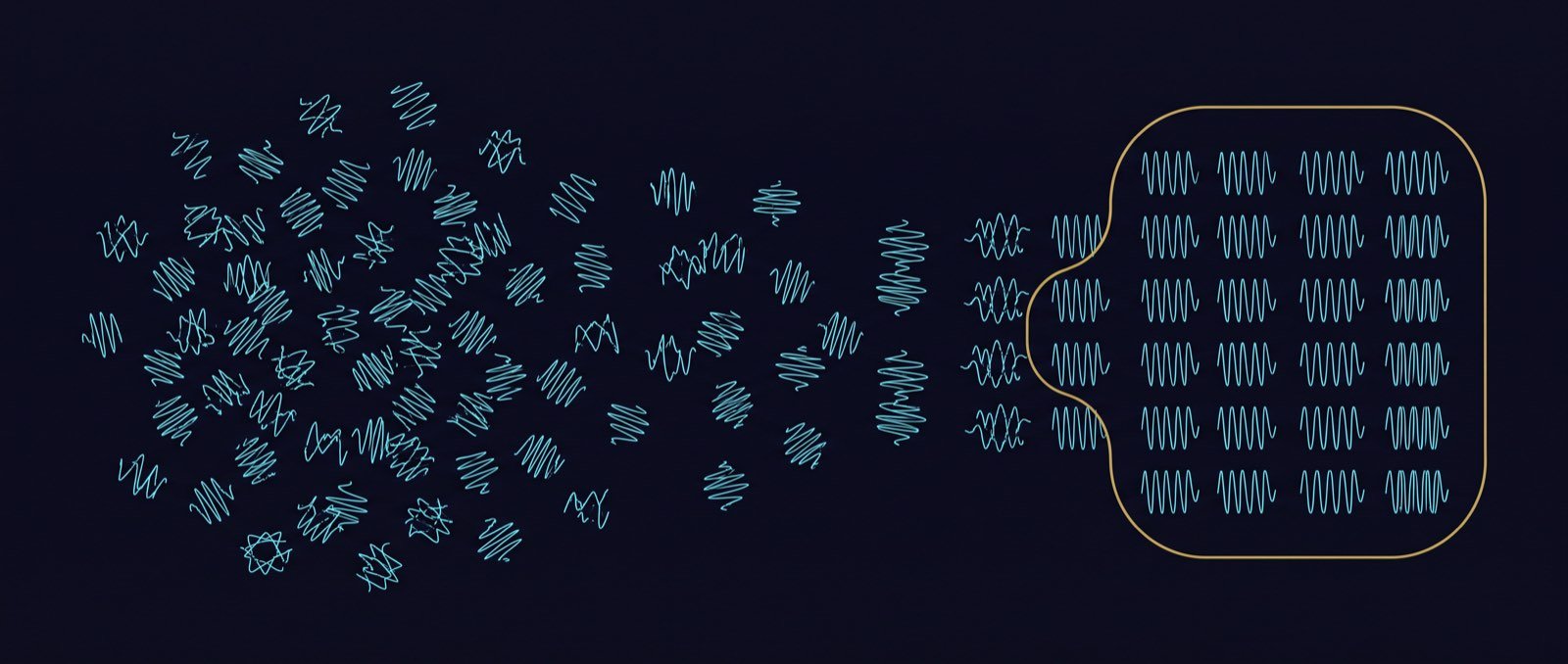
Disorder resolving into phase-locked synchrony
The basic move. What we call “consciousness” might be the brain’s coherent electromagnetic field — the phase-locked synchrony of billions of neurons firing in time. This is McFadden’s CEMI theory (2002), a peer-reviewed but minority position within consciousness studies. The Coherence reading takes it seriously because it is the most direct existing bridge between electromagnetism and subjective experience.
Why this isn’t dismissable as “consciousness is just brainwaves”. Long-term meditators show measurable high-amplitude gamma synchrony at 25–100 Hz during mental practice (Lutz et al. 2004, PNAS). The heart’s EM field is about 100× stronger than the brain’s (HeartMath research). Biophotons emitted from cells correlate with biological state — Popp’s foundational work (1984–2003) is well-established as a metabolic phenomenon; whether that emission also carries a signaling function is a separate, newer, and still-open question (see below). The pattern across these independent lines: coherent EM activity correlates with the things we associate with conscious awareness.
| Spectrum reading | Established physics |
|---|---|
| Consciousness = phase-lock of neuronal oscillators | Neural correlates of consciousness (NCC) — active research field |
Supporting evidence:
- CEMI theory (McFadden, Journal of Consciousness Studies 9, 23–50, 2002; reformulated NeuroQuantology 5, 262–270, 2007): consciousness as the brain’s coherent electromagnetic field. Peer-reviewed but minority position; the most direct existing bridge between EM and subjective experience.
- Long-term meditators show high-amplitude gamma synchrony: Lutz, Greischar, Rawlings, Ricard, Davidson, PNAS 101, 16369–16373 (2004).
- Biophotons — two layers. (1) Established metabolic fact: cells emit ultraweak photon emission (UPE); disease correlates with loss of coherence (Popp, Cell Biophysics, Springer 1984–2001; Popp 2003 review). Confirmed in living systems: Salari et al., J. Phys. Chem. Lett. 16, 4354–4362 (2025) — living mice emit significantly more UPE than dead ones, vanishing immediately at death; the authors are explicit that this is a metabolic byproduct, “comparable to a glow-stick,” not evidence of signaling on its own. (2) Open signaling hypothesis: the first serious empirical hint of a functional role — Casey et al., iScience 28:112019 (2025) — found that brain UPE responds dynamically to cognitive tasks and correlates weakly with brain rhythms, with neurons showing possible waveguide-like properties. The authors call the functional role “uncertain.” Correlation is not yet causation.
Bridge 6 — Vacuum ≠ Empty
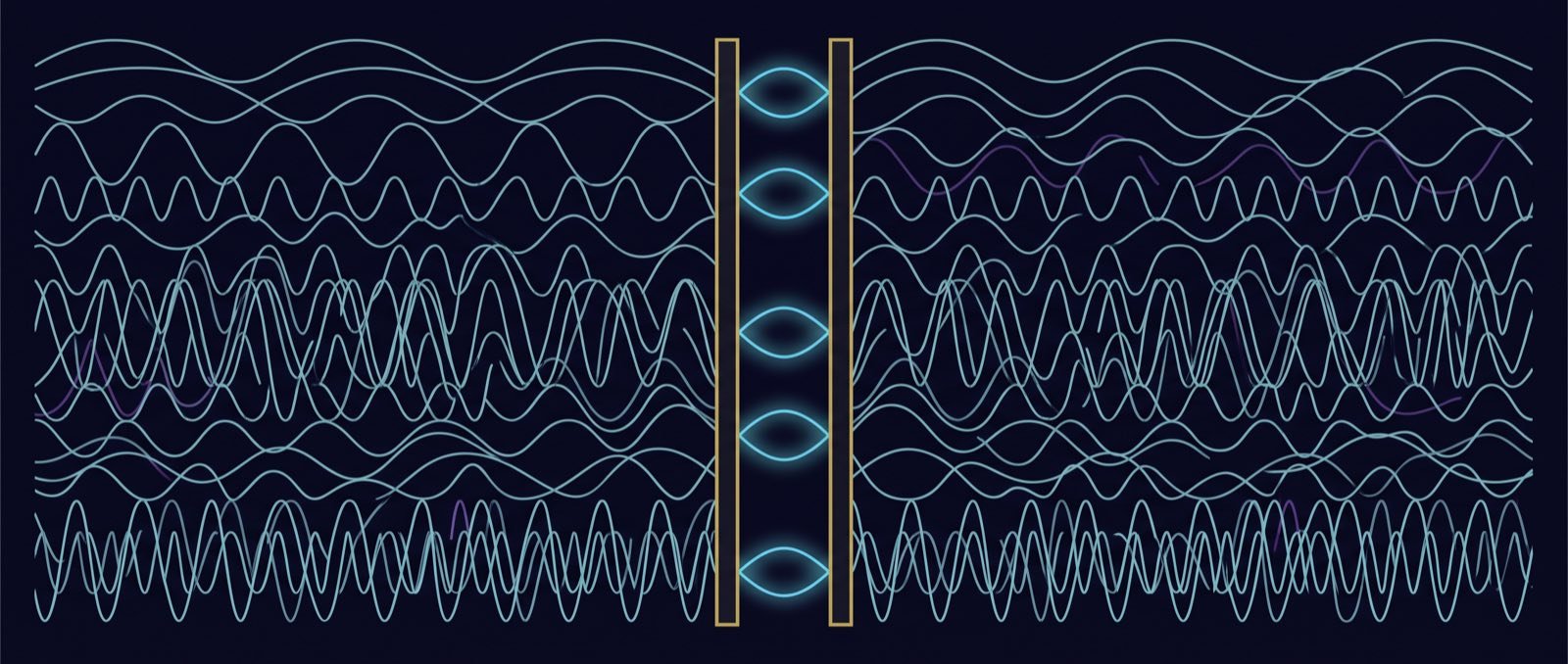
Modes excluded between the plates; the vacuum outside is energetically busy
The basic move. The quantum vacuum is not empty. Casimir showed this in 1948 (predicted); Lamoreaux measured it in 1997 (confirmed). Two metal plates in vacuum attract each other because of vacuum-fluctuation pressure. The Lamb shift in hydrogen (1947) is another direct measurement of vacuum effects. The Coherence framing — that “0 Hz” is pure potential, not nothing — corresponds to this established empirical picture.
Why this is convergent rather than additional. The Spectrum reading on the vacuum is not novel physics. Quantum field theory already says the vacuum is energetically active; the Coherence framework just uses a different vocabulary to point at the same phenomenon. This bridge is included for completeness — to show where the framework lines up with 75-year-old established physics, not where it adds new claims.
| Spectrum reading | Established physics |
|---|---|
| 0 Hz = pure potential = quantum vacuum | The vacuum contains quantum fluctuations |
Supporting evidence:
- Casimir effect (Casimir 1948 Proc. K. Ned. Akad. Wet. 51, 793; first direct measurement: Lamoreaux, Phys. Rev. Lett. 78, 5–8 (1997)): two plates in vacuum attract via quantum fluctuations. The vacuum is energetically active.
- Stochastic Electrodynamics (SED): classical EM + zero-point energy as a formal basis for vacuum energy.
- Lamb shift (1947): energy shift in hydrogen due to vacuum fluctuations — proven, repeatable, and predicted by QED to high precision.
Bridge 7 — 3D Modulation as Helix Waves
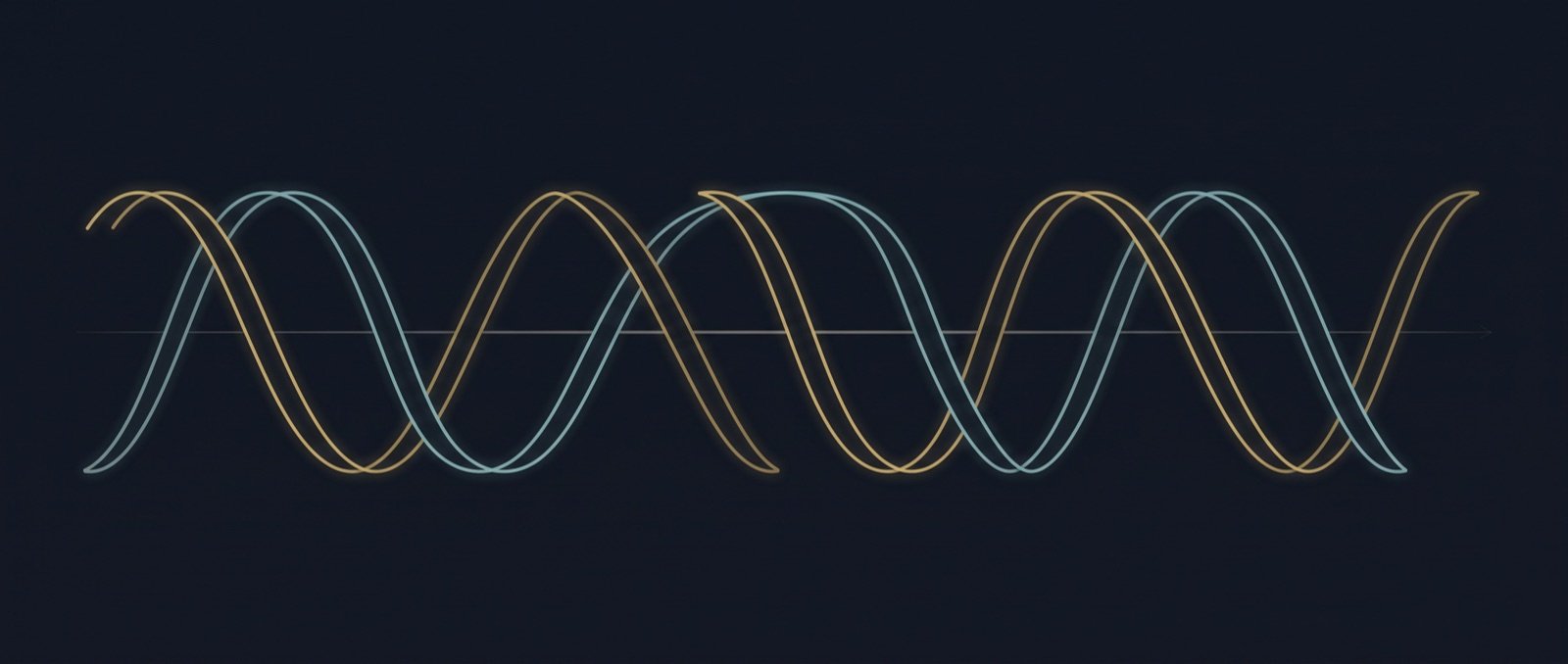
Circularly polarised light traces a helix as it propagates
The basic move. A 2D sine wave is what you draw on a chalkboard; circularly polarised light rotates as it propagates and traces a helix, and that is standard physics. What this bridge does not claim is that the helix is therefore the more fundamental object — circular and linear polarisation are two bases for the same space, and each is a sum of the other. The claim that survives is narrower: where chirality matters, the circular basis is the natural one to work in. And chirality demonstrably matters — handedness determines which waves couple with which, which is exactly what the CISS effect (Chirality-Induced Spin Selectivity) shows at the molecular level.
Where this leads. DNA is a double helix. Watson and Crick (1953). The dimensions 34 × 21 ångström happen to be Fibonacci numbers (34/21 ≈ φ). The framework asks whether DNA functions not only as a database but as a biological carrier wave — genes as modulated signals, expression as demodulation. This is a strong “what if” — speculative, but testable: phase-coherent EM stimulation at chiral-resonant frequencies should produce reproducible expression changes beyond chance, or not.
| Spectrum reading | Established physics |
|---|---|
| Where chirality matters, the circular basis is the natural description | Circular and linear polarization are equivalent bases; circularly polarized light traces a helix (standard physics) |
| Chirality determines which waves couple | Biological homochirality (L-amino acids, D-sugars) |
Supporting evidence:
- Circular polarization: EM light can rotate as it propagates, tracing a helix — proven, standard physics. Note the basis, not the ontology: a linearly polarized wave is the sum of two opposite circular ones, so neither description is prior to the other.
- CISS effect: chiral molecules selectively filter spin-polarized electrons by handedness. Foundational paper: Naaman & Waldeck, J. Phys. Chem. Lett. 3, 2178–2187 (2012). Updated with 2024–2026 evidence: up to 60% spin polarization in DNA helices (Bloom et al., Chem. Rev. 2024); ~160 meV effective spin-orbit coupling from helix geometry alone, independent of atomic composition (Sala et al., Nanoscale 2026); denaturation abolishes spin selectivity — the helical secondary structure, not the amino-acid sequence, is the active unit (Preeyanka & Naaman, JPCL 2025); helicity locking analogous to circularly polarized light (Waldeck, Naaman & Subotnik, Physics Today 2026). Precision note: CISS is a spin filter, not a frequency filter directly. The Coherence frequency-filter reading is a further hypothesis that CISS supports but does not prove.
- Watson & Crick (1953): DNA structure is a double helix — mathematically a twisted pair.
- DNA dimensions: 34 Å × 21 Å → Fibonacci ratio
34/21 ≈ φ(Harel et al., MDPI Symmetry 2021).
Honest limitations
Four points where the framework is honest about its current state:
- No formal Lagrangian yet. The Coherence framework has verbal predictions and intuitions, but no compact equation that reduces to the Standard Model in known limits. That is the central theoretical gap.
- Dimensional care needed.
candc²are not the same units. Several pieces of verbal phrasing in earlier drafts conflated them. The dimensional rigour matters and is being tightened across the manuscript. - Testability backlog. There are 34 open testable predictions on the peer-review page and four post-dictions on the originals page. Four predictions have been benchmarked; one falsified, one partial, two remain open. The framework grows by these tests.
- The Nautilus correction. The shell ratio of Nautilus pompilius is ≈ 1.33, not φ ≈ 1.618. This common pop-science claim has been removed.
- Lacks a formal Lagrangian. The Coherence framework has intuitions and verbal predictions but no Lagrangian or wave equation. A formalism that reduces to the Standard Model + GR in known limits is the next-step theoretical task.
- Dimensional carefulness.
candc²are not the same units — the informal language must respect this. Several published verbal claims need reformulation in dimensionally consistent terms. - Testability backlog. The site lists 34 open testable predictions (see /peer-review/) and four post-dictions (see /predictions/originals/). Four predictions have been benchmarked against the literature; one was falsified, one is partial, two remain open. The framework grows by these tests.
- Nautilus-correction. The shell ratio of Nautilus pompilius is ≈ 1.33, not φ. This common pop-science claim has been removed from the framework.
A note to working physicists
If you read a bridge and disagree, the framework wants the disagreement. Particularly welcome: critiques of bridges 1, 2, 5, and 7 — those make the strongest claims and have the most to gain or lose from peer scrutiny.
Contact: marald@gmail.com.
Last updated: